
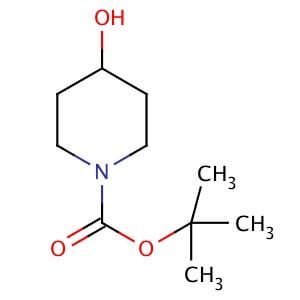
Buy 1-Boc-4-hydroxypiperidine (CAS 109384-19-2)
Buy 1-Boc-4-hydroxypiperidine (CAS 109384-19-2)
N-Boc-4-hydroxypiperidine
Unprotected 4-hydroxypiperidine introduces uncontrolled side reactions and tedious purifications in multi-step syntheses. N-Boc-4-hydroxypiperidine (CAS 109384-19-2) resolves this with its Boc-protected nitrogen, enabling orthogonal transformations exclusively at the free 4-hydroxyl group. • Crystalline solid (mp 60-65 °C) compatible with automated weighing and solid-phase synthesis platforms • High-yielding Mitsunobu etherification for constructing N-heterocyclic alkyl ether libraries • Achiral, scalable Al(OiPr)₃-mediated synthesis supports cost-effective process-scale campaigns
Technical Parameters
Basic Identity
| Product Name | N-Boc-4-hydroxypiperidine |
|---|---|
| CAS | 109384-19-2 |
| Synonyms | 1,1-Dimethylethyl 4-Hydroxypiperidine-1-carboxylate; 1-(tert-Butoxycarbonyl)-4-hydroxypiperidine; 1-(tert-Butyloxycarbonyl)piperidin-4-ol; 1-Boc-4-Hydroxypiperidine; 1-Boc-piperidin-4-ol; 1-tert-Butoxycarbonyl-4-piperidinol; 1-tert-Butyloxycarbonyl-4 |
| Molecular Formula | C10H19NO3 |
| Molecular Weight | 201.26 g/mol |
Structural Identifiers
| SMILES | CC(C)(C)OC(=O)N1CCC(CC1)O |
|---|---|
| InChI | InChI=1S/C10H19NO3/c1-10(2,3)14-9(13)11-6-4-8(12)5-7-11/h8,12H,4-7H2,1-3H3 |
| InChIKey | PWQLFIKTGRINFF-UHFFFAOYSA-N |
Commercial & Availability
| Standard Pack Sizes | 1 g / 5 g / 25 g / 100 g / Bulk Custom |
|---|---|
| Availability | In Stock |
| Custom Synthesis | Available on request |
Tert-butyl 4-hydroxypiperidine-1-carboxylate (CAS 109384-19-2): A Foundational N-Boc-Protected Piperidine Building Block for Pharmaceutical Synthesis
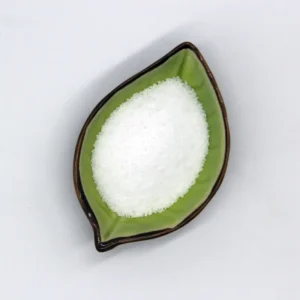
Tert-butyl 4-hydroxypiperidine-1-carboxylate (N-Boc-4-hydroxypiperidine) is a key heterocyclic building block characterized by a six-membered piperidine ring featuring a secondary hydroxyl group at the 4-position and a tert-butoxycarbonyl (Boc) protecting group on the ring nitrogen [1]. This compound, a white to off-white crystalline solid with a melting point range of 60–65 °C , serves as a versatile intermediate in medicinal chemistry. Its orthogonal protection strategy allows for selective transformations of the hydroxyl group while preserving the amine for later-stage deprotection, making it a preferred scaffold for the construction of complex, biologically active molecules [1].
Why a Simple 4-Hydroxypiperidine Analog Cannot Substitute for the Boc-Protected Derivative
Direct substitution of tert-butyl 4-hydroxypiperidine-1-carboxylate with its unprotected analog (4-hydroxypiperidine) or other positional isomers is chemically and procedurally invalid. The Boc protecting group is not a passive bystander; it fundamentally alters the compound’s physical state (solid vs. hygroscopic solid/liquid) and synthetic utility . Without the Boc group, the reactive secondary amine leads to uncontrolled side reactions and complex purification challenges, significantly reducing overall synthetic efficiency [1]. This crucial protection strategy is the primary driver of this compound’s selection over its unprotected counterpart for multi-step syntheses.
Quantitative Differentiation of Tert-butyl 4-hydroxypiperidine-1-carboxylate: A Comparator-Based Analysis
Melting Point Comparison: Solid-State Handling Advantage Over Positional Isomers and Unprotected Analogs
Tert-butyl 4-hydroxypiperidine-1-carboxylate exhibits a melting point range of 60–65 °C , placing it in a distinct and advantageous physical state relative to its close analogs. This is in stark contrast to the 3-hydroxypiperidine isomer (N-Boc-3-hydroxypiperidine), which is often a viscous liquid or a low-melting solid (43–50 °C for racemate) , and the unprotected 4-hydroxypiperidine, which is a higher-melting solid (86–90 °C) with significant hygroscopicity . The intermediate melting point and crystallinity of the target compound provide a unique balance of easy handling, purification, and storage stability compared to its liquid, low-melting, or highly hygroscopic alternatives.
Synthetic Yield Comparison: High-Efficiency Preparation via Aluminum Isopropoxide Reduction
A reported large-scale synthesis of tert-butyl 4-hydroxypiperidine-1-carboxylate from N-Boc-4-piperidone utilizes an aluminum isopropoxide reduction in a Meerwein-Ponndorf-Verley (MPV) type reaction. This method yields the target compound as a white solid in high purity (GC content 99.1%) and with an isolated mass of 156.3 g from 180.5 g of the piperidone intermediate . While no direct head-to-head yield comparison for this specific step is available for the 3-isomer, the reported high yield and straightforward purification via recrystallization contrast with the lower yields and more complex biocatalytic resolutions often required for the enantiomerically pure (S)-N-Boc-3-hydroxypiperidine [1], highlighting a more robust and scalable process for the racemic 4-hydroxy derivative.
N-BOC-4-Hydroxypiperidine – ChemicalBook


Reviews
There are no reviews yet.