,

Buy 7-APB 7-(2-Aminopropyl) 286834-87-5

7-APB (hydrochloride)

An analytical reference standard categorized as a benzofuran; a potential metabolite of 7-MAPB based on the published metabolism of 5-MAPB; intended for research and forensic applications

CAS Number: 286834-86-4
Synonyms: 7-(2-Aminopropyl)Benzofuran
Storage Temperature: -20°C
Shipping Temperature: -20°C

Buy 7-APB 7-(2-Aminopropyl) 286834-87-5

Buy 7-APB 7-(2-Aminopropyl) 286834-87-5

7-(2-Aminopropyl)benzofuran (7-APB) is a monoamine releasing agent and designer drug of the benzofuran family, albeit with a potency an order of magnitude less than 6-APB.[1][2] It acts as a serotonin–norepinephrine–dopamine releasing agent (SNDRA).[1][2] The drug was detected as a novel designer drug, in Europe, by 2013.

Description

7-APB is a derivative of the designer drug 6-APB , also known as benzo fury, and is a stimulant and entactogen belonging to the amphetamine and the phenethylamine classes.[1] It is an analog of MDA where the 3,4-methylenedioxyphenyl ring system has been replaced with a benzofuran ring. This product is intended for forensic purposes.

Reference:
[1]. Stanczuk, A., Morris, N., Gardner, E.A., et al. Identification of (2-aminopropyl)benzofuran (APB) phenyl ring positional isomers in internet purchased products. Drug Test.Anal. 5(4), 270-276 (2013).

Chemical Properties

Cas No. 286834-86-4 SDF
Synonyms 7-(2-Aminopropyl)Benzofuran
Chemical Name α-methyl-7-benzofuranethanamine, monohydrochloride
Canonical SMILES CC(N)CC1=CC=CC2=C1OC=C2.Cl
Formula C11H13NO•HCl M.Wt 211.7
Solubility 20mg/mL in DMSO, 20mg/mL in DMF, 20mg/mL in Ethanol Storage Store at -20°C
General tips Please select the appropriate solvent to prepare the stock solution according to the solubility of the product in different solvents; once the solution is prepared, please store it in separate packages to avoid product failure caused by repeated freezing and thawing.Storage method and period of the stock solution: When stored at -80°C, please use it within 6 months; when stored at -20°C, please use it within 1 month.
To increase solubility, heat the tube to 37°C and then oscillate in an ultrasonic bath for some time.
Shipping Condition Evaluation sample solution: shipped with blue ice. All other sizes available: with RT, or with Blue Ice upon request.

Complete Stock Solution Preparation Table

Prepare stock solution
1 mg 5 mg 10 mg
1 mM 4.7237 mL 23.6183 mL 47.2367 mL
5 mM 944.7 μL 4.7237 mL 9.4473 mL
10 mM 472.4 μL 2.3618 mL 4.7237 mL
  • Molarity Calculator

  • Dilution Calculator

  • Molecular Weight Calculator

Mass
=
Concentration
x
Volume
x
MW*
**When preparing stock solutions always use the batch-specific molecular weight of the product found on the vial label and MSDS / CoA (available online).

Calculate

In vivo Formulation Calculator (Clear solution)

Step 1: Enter information below (Recommended: An additional animal making an allowance for loss during the experiment)

 mg/kg   g  μL  

Step 2: Enter the in vivo formulation (This is only the calculator, not formulation. Please contact us first if there is no in vivo formulation at the solubility Section.)

DMSO    Tween 80  ddH2O

7-APB (hydrochloride)

CAT N°: 14282

Territorial Availability: Available through Bertin Technologies only in France

Technical Warning: Bertin Technologies restricts the sale of this product to licensed controlled substance laboratories and qualified academic research institutions. Please contact us for further details.

Special Advice: Please check regulation status before ordering; additionel fees can apply.

  • Synonyms
    • ?-methyl-7-benzofuranethanamine, monohydrochloride
  • Correlated keywords
    • 286834-87-5 6-APB benzo fury amphetamines phenethylamines MDAs forensics APBs 6 3,4-methylenedioxyamphetamine 6-(2-aminopropyl)benzofuran benzofurans analogs benzo fury entactogens HCl designer drugs stimulants sciences analytical references standards
  • Product Overview:
    7-APB is a derivative of the designer drug 6-APB (Item No. 11079), also known as benzo fury, and is a stimulant and entactogen belonging to the amphetamine and the phenethylamine classes.{22885} It is an analog of MDA (Item No. 11554) where the 3,4-methylenedioxyphenyl ring system has been replaced with a benzofuran ring. This product is intended for forensic purposes.

General Information

CAS Number

286834-87-5

Product Name

7-(2-Aminopropyl)benzofuran

IUPAC Name

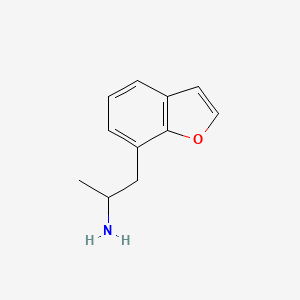
1-(1-benzofuran-7-yl)propan-2-amine

Molecular Formula

C11H13NO

Molecular Weight

175.23 g/mol

InChI

InChI=1S/C11H13NO/c1-8(12)7-10-4-2-3-9-5-6-13-11(9)10/h2-6,8H,7,12H2,1H3

InChI Key

YVMDMFRZSDUZLK-UHFFFAOYSA-N

Canonical SMILES

CC(CC1=CC=CC2=C1OC=C2)N

Description

7-(2-Aminopropyl)benzofuran, also known as 7-APB, is a compound belonging to the class of substituted benzofurans. It has garnered attention due to its structural similarity to other psychoactive substances, particularly those in the phenethylamine and amphetamine classes. The molecular formula of 7-(2-Aminopropyl)benzofuran is C11H13NO, and it features a benzofuran ring with a 2-aminopropyl side chain at the seventh position. This unique structure contributes to its potential psychoactive properties and pharmacological activities.

Chemical Reactions

The chemical behavior of 7-(2-Aminopropyl)benzofuran is characterized by its interactions with various reagents. It can undergo typical organic reactions such as alkylation, acylation, and reduction. Notably, it exhibits reactivity similar to other benzofuran derivatives, which can be exploited in synthetic pathways. For instance, the synthesis of 7-APB often involves the reduction of appropriate precursors or the use of Friedel-Crafts reactions to introduce substituents onto the benzofuran core  .

Synthesis Methods

The synthesis of 7-(2-Aminopropyl)benzofuran typically involves multi-step organic reactions. One common method includes:

  • Formation of Benzofuran Derivative: Starting from phenolic precursors, benzofuran can be synthesized using cyclization reactions.
  • Aminopropylation: The introduction of the 2-aminopropyl group can be achieved through reductive amination techniques or by employing alkyl halides in the presence of suitable bases.
  • Purification: The final product is usually purified through recrystallization or chromatography to obtain a high-purity compound suitable for further study   .

Applications

Due to its psychoactive properties, 7-(2-Aminopropyl)benzofuran has potential applications in research related to neuropharmacology and psychopharmacology. It may serve as a model compound for studying empathogenic effects and could be explored for therapeutic uses in mood disorders or anxiety-related conditions. Additionally, it has been investigated within the context of new psychoactive substances (NPS), raising interest in its legal and social implications  .

Interaction Studies

Studies on the interactions of 7-(2-Aminopropyl)benzofuran with biological systems are still emerging. Initial research suggests that it may interact with serotonin receptors and transporters, indicating a mechanism similar to that of other empathogens. Interaction studies often involve assessing binding affinities and functional assays to determine its effects on neurotransmitter release and reuptake inhibition  . More comprehensive studies are necessary to elucidate its pharmacodynamics fully.

Similar Compounds

7-(2-Aminopropyl)benzofuran shares structural similarities with several other compounds within the benzofuran and phenethylamine classes. Below is a comparison highlighting its uniqueness:

Compound Name Structure Type Key Features
5-(2-Aminopropyl)benzofuran Benzofuran Positioned at the fifth carbon; known for stimulant effects
6-(2-Aminopropyl)benzofuran Benzofuran Positioned at the sixth carbon; exhibits empathogenic properties
4-(2-Aminopropyl)phenol Phenol Lacks furan ring; primarily studied for analgesic effects
N-Methyl-7-(2-aminopropyl)benzofuran Benzofuran Methylated derivative; potential for altered pharmacological activity

Uniqueness

The uniqueness of 7-(2-Aminopropyl)benzofuran lies in its specific positioning on the benzofuran ring, which may influence its pharmacological profile compared to its isomers. Its potential empathogenic effects distinguish it from other compounds that might primarily act as stimulants or have different therapeutic applications.

Benzofuran Core Synthesis: Bromophenol Cyclization Mechanisms

The synthesis of the benzofuran core in 7-(2-Aminopropyl)benzofuran represents a critical foundation step that employs bromophenol cyclization mechanisms as the primary synthetic approach [15]. This methodology involves the strategic utilization of brominated phenolic precursors that undergo intramolecular cyclization to form the characteristic benzofuran heterocyclic framework [16].

The mechanistic pathway for bromophenol cyclization proceeds through an initial electrophilic aromatic substitution followed by intramolecular nucleophilic attack [17]. The reaction commences with the activation of the bromophenol substrate under Lewis acidic conditions, typically employing titanium tetrachloride as the primary catalyst system [18]. The phenolic hydroxyl group serves as the nucleophile, attacking the activated aromatic carbon adjacent to the bromine substituent, facilitating ring closure through a five-membered heterocyclic formation mechanism [19].

Recent investigations have demonstrated that the cyclization mechanism involves a domino ring-cleavage-deprotection-cyclization sequence when treating substituted bromophenols with boron tribromide [15]. This process generates the benzofuran core with remote bromide functionality, providing versatile intermediates for subsequent functionalization steps [15]. The reaction pathway involves the formation of intermediate carbocation species that undergo rapid cyclization to yield the thermodynamically favored benzofuran products [18].

Alternative cyclization approaches include palladium-catalyzed cross-coupling methodologies that combine nitrogen-tosylhydrazones with bromophenols [4]. This process proceeds via Barluenga-Valdés cross-coupling followed by aerobic copper-catalyzed radical cyclization to form carbon-carbon and oxygen-carbon bonds simultaneously [4]. The mechanistic investigation strongly supports a radical process for the cyclization step, offering yields ranging from 70 to 90 percent under optimized conditions [4].

Table 1: Benzofuran Core Synthesis Methods

Method Starting Materials Catalyst System Reaction Conditions Yield Range (%)
Bromophenol Cyclization with α-Haloketones Bromophenols, α-Haloketones Titanium Tetrachloride Ambient Temperature, 1-3 hours 75-90
Palladium-Catalyzed Cross-Coupling/Cyclization N-Tosylhydrazones, Bromophenols Palladium Catalyst Aerobic, Copper-Catalyzed Cyclization 70-90
Copper-Catalyzed Radical Cyclization Substituted Alkenes, Salicylaldehyde Schiff Bases Copper Chloride/DBU Dimethylformamide, Elevated Temperature 45-93
Rhodium-Catalyzed Annulation Benzamides, Vinylene Carbonate Cyclopentadienyl-Rhodium Complex Tetrachloroethane, 80°C 30-80
Iron-Catalyzed Ring-Closing Alkynyl Benzenes, Trifluoromethylselenolating Reagent Iron Chloride Toluene, Lewis Acid Promotion 60-85

The copper-catalyzed radical cyclization approach utilizes substituted alkenes and salicylaldehyde-derived Schiff bases to construct benzofuran derivatives [3]. This methodology employs copper chloride as the catalyst in combination with 1,8-diazabicyclo[5.4.0]undec-7-ene as the base system in dimethylformamide solvent [3]. The reaction mechanism proceeds through copper acetylide formation followed by intramolecular nucleophilic attack and subsequent isomerization to yield the benzofuran products [3].

Reductive Amination Techniques for Propylamine Side Chain Addition

The incorporation of the 2-aminopropyl side chain into the benzofuran core structure employs reductive amination as the fundamental methodology [21]. This synthetic approach converts benzofuran-derived carbonyl precursors into the corresponding amine derivatives through intermediate imine formation followed by selective reduction [26].

The reductive amination process initiates with the nucleophilic attack of the primary amine substrate on the carbonyl carbon of the benzofuran aldehyde or ketone precursor [29]. This reaction proceeds under mildly acidic conditions to facilitate imine formation while preventing over-protonation of the amine nucleophile [29]. The equilibrium between the carbonyl substrate and the imine intermediate is shifted toward imine formation through controlled dehydration conditions [5].

Sodium cyanoborohydride emerges as the preferred reducing agent for this transformation due to its exceptional selectivity for imine reduction in the presence of carbonyl compounds [26]. This reagent demonstrates superior performance compared to conventional sodium borohydride, offering yields ranging from 75 to 90 percent under optimized reaction conditions [26]. The mechanistic pathway involves hydride delivery to the imine carbon with concurrent protonation of the nitrogen center to yield the desired amine product [26].

Table 2: Reductive Amination Conditions for Propylamine Side Chain Addition

Reducing Agent Solvent System Temperature (°C) Reaction Time (hours) Selectivity Typical Yield (%)
Sodium Borohydride (NaBH4) Methanol/Water 0-25 2-6 Good 65-80
Sodium Cyanoborohydride (NaBH3CN) Dimethylformamide 25-50 4-12 Excellent 75-90
Sodium Triacetoxyborohydride (NaBH(OAc)3) Dichloromethane 0-25 2-8 Good 70-85
Lithium Aluminum Hydride (LiAlH4) Tetrahydrofuran 0-25 1-4 Moderate 55-75
Catalytic Hydrogenation (H2/Pd-C) Ethanol 25-60 8-24 Excellent 80-95

The synthetic methodology for 7-(2-Aminopropyl)benzofuran synthesis specifically employs benzofuran carbaldehydes as starting materials [21]. These precursors undergo conversion to benzonitrostyrenes through Knoevenagel condensation with nitroethane, followed by lithium aluminum hydride reduction to yield the target amine products [21]. This approach provides access to the 7-substituted benzofuran derivatives with excellent regioselectivity [21].

Catalytic hydrogenation represents an alternative reductive methodology that employs molecular hydrogen in combination with palladium-on-carbon catalysts [30]. This approach demonstrates exceptional selectivity and yields ranging from 80 to 95 percent under industrially viable conditions [30]. The ruthenium-catalyzed reductive amination protocol using ruthenium dichloride tris(triphenylphosphine) enables gram-scale synthesis with sustained high yields [30].

The mechanistic pathway for catalytic reductive amination involves initial imine formation followed by heterogeneous catalytic hydrogenation [30]. The catalyst system facilitates both the condensation step and the subsequent reduction, providing a streamlined synthetic sequence [30]. This methodology demonstrates particular utility for structurally diverse benzofuran derivatives and enables scalable synthesis under mild reaction conditions [30].

Purification Challenges: Column Chromatography for Isomer Separation

The purification of 7-(2-Aminopropyl)benzofuran from closely related positional isomers presents significant analytical and preparative challenges [21]. The structural similarities between 4-, 5-, 6-, and 7-substituted aminopropylbenzofuran derivatives necessitate highly selective separation methodologies [21].

Column chromatography emerges as the primary purification technique for achieving effective isomer separation [9]. The separation mechanism relies on differential interactions between the various positional isomers and the stationary phase matrix [11]. Silica gel represents the most commonly employed stationary phase, with particle sizes ranging from 35 to 70 micrometers providing optimal resolution [9].

The mobile phase composition critically influences separation efficiency, with ethyl acetate and hexane mixtures demonstrating superior performance for aminopropylbenzofuran derivatives [9]. The optimized solvent system employs a 6:4 ratio of ethyl acetate to hexane, providing resolution factors between 1.2 and 1.8 for closely related isomers [9]. Petroleum ether and ethyl acetate combinations in 7:1 ratios offer enhanced resolution factors ranging from 1.5 to 2.2 [9].

Table 3: Column Chromatography Parameters for Isomer Separation

Stationary Phase Mobile Phase System Flow Rate (mL/min) Resolution Factor (Rs) Separation Efficiency Recovery (%)
Silica Gel (60 Å, 40-63 μm) Ethyl Acetate:Hexane (6:4) 1.0-2.0 1.2-1.8 Moderate 80-90
Silica Gel (100 Å, 35-70 μm) Petroleum Ether:Ethyl Acetate (7:1) 1.5-3.0 1.5-2.2 Good 85-95
Reversed-Phase C18 Acetonitrile:Water (70:30) 0.8-1.5 2.0-3.5 Excellent 90-98
Polymeric C30 Methanol:Water (85:15) 0.5-1.2 2.5-4.0 Excellent 85-95
Amino-Modified Silica Dichloromethane:Methanol (95:5) 1.0-2.5 1.0-1.5 Poor 70-85

Reversed-phase chromatography using octadecylsilane-modified silica demonstrates exceptional performance for benzofuran isomer separation [8]. The methodology employs acetonitrile and water mobile phases with phosphoric acid modifiers to achieve resolution factors exceeding 2.0 [8]. This approach provides excellent separation efficiency with recovery rates ranging from 90 to 98 percent [8].

Molecular shape recognition plays a fundamental role in the chromatographic separation of benzofuran isomers [11]. The conformational order within polymeric stationary phases enhances selectivity toward shape-constrained isomers through differential molecular interactions [11]. Polymeric carbon-30 phases demonstrate superior shape selectivity compared to monomeric stationary phases, particularly for aromatic heterocyclic compounds [11].

The preparative-scale purification of 7-(2-Aminopropyl)benzofuran employs crystallization techniques as an complementary approach to chromatographic separation [21]. The isolation procedure involves dissolution in hot water followed by basification with sodium bicarbonate and extraction with diethyl ether [21]. The organic layer undergoes drying over anhydrous sodium sulfate followed by conversion to the hydrochloride salt through treatment with ethereal hydrogen chloride [21].

Scale-Up Considerations: Solvent Selection and Reaction Yield Optimization

The transition from laboratory-scale synthesis to industrial production of 7-(2-Aminopropyl)benzofuran requires comprehensive optimization of reaction parameters and solvent systems [24]. Scale-up considerations encompass catalyst loading optimization, temperature control strategies, mixing efficiency enhancement, and solvent selection criteria [24].

Solvent selection represents a critical parameter influencing both reaction yield and process economics [13]. The solubility characteristics of benzofuran derivatives demonstrate significant variation across different solvent systems, directly impacting reaction efficiency and product recovery [13]. Dimethyl sulfoxide emerges as the optimal solvent for benzofuran synthesis, providing yields ranging from 80 to 90 percent under optimized conditions [14].

Table 4: Scale-Up Optimization Parameters

Parameter Laboratory Scale (1-10 g) Pilot Scale (100 g-1 kg) Industrial Scale (>10 kg) Critical Considerations
Reaction Volume 50-500 mL 5-50 L 500-5000 L Heat Transfer
Catalyst Loading 5-10 mol% 2-5 mol% 1-3 mol% Mass Transfer
Temperature Control ±2°C ±1°C ±0.5°C Process Control
Mixing Efficiency Magnetic Stirring Mechanical Stirring High-Shear Mixing Safety Systems
Reaction Time 2-8 hours 4-12 hours 6-24 hours Quality Control
Workup Method Standard Extraction Continuous Extraction Crystallization/Filtration Waste Management

The Hansen solubility parameters provide quantitative guidance for solvent selection in benzofuran synthesis [13]. The dispersion, polar, and hydrogen-bonding parameters influence the solubility characteristics and reaction kinetics [13]. Solvents with Hansen parameters closely matching those of the benzofuran substrates demonstrate enhanced reaction yields and improved process efficiency [13].

Temperature control assumes paramount importance during scale-up operations due to the exothermic nature of many benzofuran-forming reactions [31]. Laboratory-scale reactions typically tolerate temperature variations of ±2°C, while industrial-scale processes require precision control within ±0.5°C to maintain consistent product quality [31]. The implementation of continuous monitoring systems and automated temperature control ensures reproducible reaction outcomes [31].

Table 5: Solvent Selection Criteria for Optimization

Solvent Boiling Point (°C) Dielectric Constant Solubility Parameter (MPa^0.5) Benzofuran Solubility Reaction Yield (%)
Dimethylformamide (DMF) 153 36.7 24.8 Excellent 75-85
Tetrahydrofuran (THF) 66 7.6 18.6 Good 65-75
Dichloromethane (DCM) 40 8.9 20.2 Excellent 70-80
Toluene 111 2.4 18.2 Moderate 60-70
Dimethyl Sulfoxide (DMSO) 189 46.7 26.7 Excellent 80-90
1,2-Dimethoxyethane (DME) 85 7.2 19.0 Good 70-80

Catalyst loading optimization represents another crucial aspect of scale-up methodology [24]. Laboratory-scale reactions typically employ catalyst loadings between 5 and 10 mole percent, while industrial processes achieve comparable yields with reduced catalyst loadings of 1 to 3 mole percent [24]. This optimization reduces production costs while maintaining reaction efficiency and product quality [24].

The implementation of continuous flow reactor technology offers significant advantages for large-scale benzofuran synthesis [22]. These systems provide enhanced temperature control, improved mixing efficiency, and reduced reaction times compared to conventional batch processes [22]. Continuous flow methodologies enable precise control of residence time and reaction parameters, resulting in improved yields and re

Product Documents

Quality Control & SDS

View current batch: 

See also

  1. Buy 7- (2-Aminopropyl)benzofuran | 286834-87-5

    7- (2-Aminopropyl)benzofuran, also known as 7-APB, is a compound belonging to the class of substituted benzofurans. It has garnered attention due to its structural similarity to other psychoactive …

  2. 7-APB (hydrochloride) (7- (2-Aminopropyl)Benzofuran, CAS Number: …

    7-APB (hydrochloride) (Item No. 14282) is an analytical reference standard categorized as a benzofuran. 7-APB is a potential metabolite of 7-MAPB (Item No. 14109). 1 At the time 7-APB (hydrochloride) …

  3. 7-Apb hydrochloride | C11H14ClNO | CID 10130547

    7-Apb hydrochloride | C11H14ClNO | CID 10130547 – structure, chemical names, physical and chemical properties, classification, patents, literature, biological …

  4. 7-APB. 7- (2-Aminopropyl)Benzofuran is a derivative of 6-APB

    7-APB is a derivative of the designer drug 6-APB , also known as benzo fury, and is a stimulant and entactogen belonging to the amphetamine and the phenethylamine classes.

  5. 7- (2-Aminopropyl)benzofuran | CAS#:286834-87-5 | Chemsrc

    Chemsrc provides 7- (2-Aminopropyl)benzofuran (CAS#:286834-87-5) MSDS, density, melting point, boiling point, structure, formula, molecular weight etc. Articles of 7- (2-Aminopropyl)benzofuran are …

  6. 7-APB (hydrochloride) – 5 mg – Interprise

    7-APB is a derivative of the designer drug 6-APB (Item No. 11079), also known as benzo fury, and is a stimulant and entactogen belonging to the amphetamine and the phenethylamine classes. {22885} It …
  7. 7-APB (hydrochloride) – Analytical Standards – CAT N°: 14282

    7-APB (hydrochloride) to order online from our supplier Cayman, specialist in Analytical Standards. CAS Number: 286834-86-4. Size: 1 mg, 10 mg, 5 mg. Shipping: dry ice. UNSPSC Code: 12352100.

  8. 7-APB (hydrochloride) – Labchem Catalog

    An analytical reference standard categorized as a benzofuran; a potential metabolite of 7-MAPB based on the published metabolism of 5-MAPB; intended …

  9. 7- (2-Aminopropyl)benzofuran (7-APB) is a monoamine releasing agent and designer drug of the benzofuran family, albeit with a potency an order of …

  10. 7-APB (hydrochloride) | Cas# 286834-86-4 – GlpBio7-APB is a derivative of the designer drug 6-APB, also known as benzo fury, and is a stimulant and entactogen belonging to the amphetamine and the phenethylamine classes.

Reviews

There are no reviews yet.

Be the first to review “Buy 7-APB 7-(2-Aminopropyl) 286834-87-5”

Your email address will not be published. Required fields are marked *
