
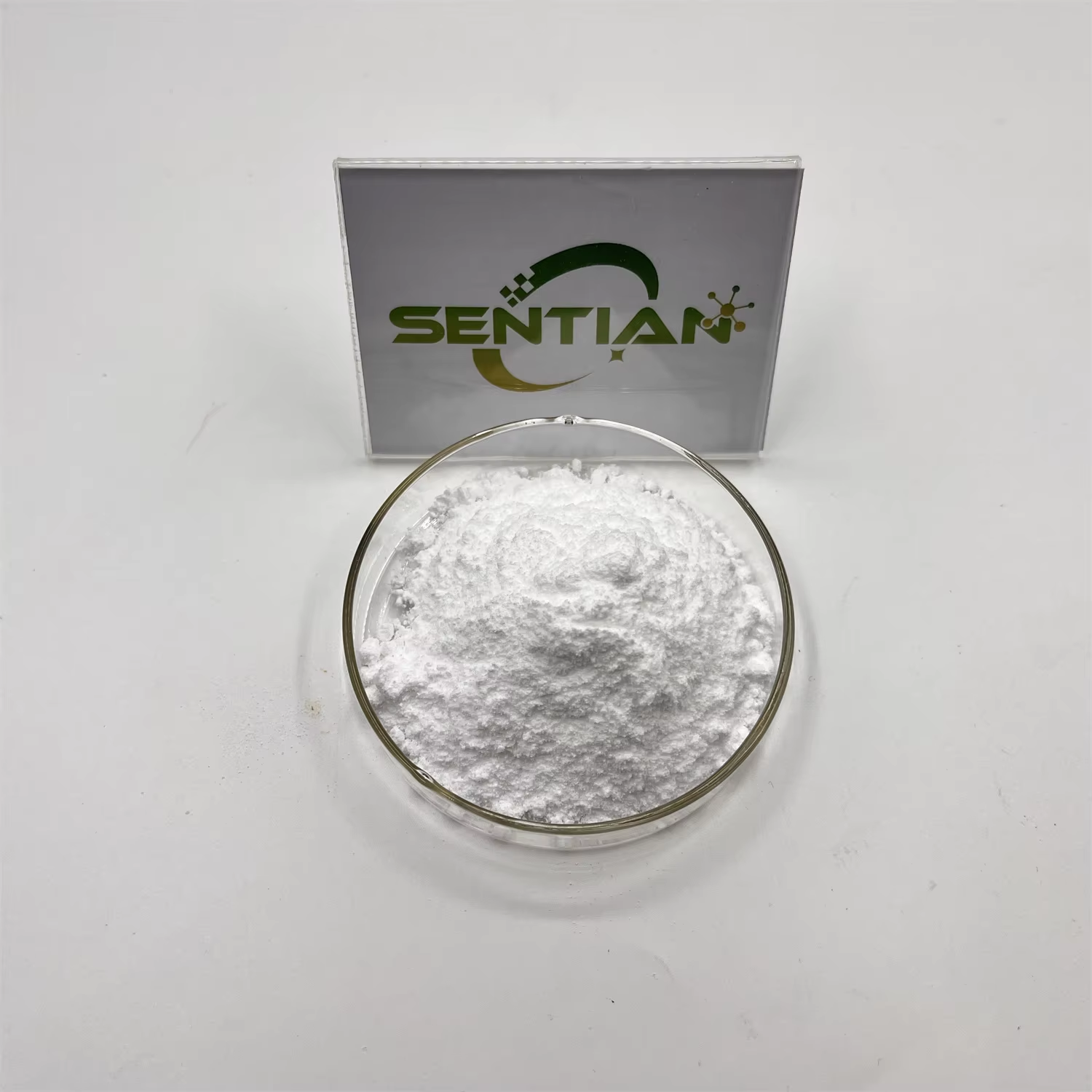
Buy amino acid Glycine Cas-56-40-6
Buy amino acid Glycine Cas-56-40-6
Glycine (symbol Gly or G;[6] /ˈɡlaɪsiːn/ ⓘ[7]) is an organic compound with the formula C2H5NO2, and is the simplest stable amino acid, distinguished by having a single hydrogen atom as its side chain. As one of the 20 proteinogenic amino acids, glycine is a fundamental building block of proteins in all life and is encoded by all codons starting with GG (GGU, GGC, GGA, and GGG).[8][9] Because of its minimal side chain, it is the only common amino acid that is not chiral, meaning it is superimposable on its mirror image.[10][11]
In the body, glycine plays several crucial roles. Its small and flexible structure is vital for the formation of certain protein structures, most notably in collagen, where glycine makes up about 35% of the amino acid content and enables the tight coiling of the collagen triple helix.[8][12] Glycine disrupts the formation of alpha-helices in secondary protein structure, in favor instead of random coils.[13] Beyond its structural role, glycine functions as an inhibitory neurotransmitter in the central nervous system,[14] particularly in the spinal cord and brainstem, where it helps regulate motor and sensory signals. Disruption of glycine signaling can lead to severe neurological disorders and motor dysfunction;[15] for example, the tetanus toxin causes spastic paralysis by blocking glycine release.[16] It also serves as a key precursor for the synthesis of other important biomolecules, including the porphyrins that form heme in blood and the purines used to build DNA and RNA.[8]
Glycine is a white, sweet-tasting crystalline solid, leading to its name from Greek word glykys (Greek: γλυκύς) or “sweet”.[17][7] While the body can synthesize it, it is also obtained from the diet and produced industrially by chemical synthesis for use as a food additive, a nutritional supplement, and an intermediate in the manufacture of products such as the herbicide glyphosate.[18] In aqueous solutions, glycine exists predominantly as a zwitterion (H3N+CH2COO–), a polar molecule with both a positive and negative charge, making it highly soluble in water.[19] It can also fit into hydrophobic environments due to its minimal side chain.[20]
History and etymology
Glycine was discovered in 1820 by French chemist Henri Braconnot when he hydrolyzed gelatin by boiling it with sulfuric acid.[21] He originally called it “sugar of gelatin”,[22][23] but French chemist Jean-Baptiste Boussingault showed in 1838 that it contained nitrogen.[24] In 1847 American scientist Eben Norton Horsford, then a student of the German chemist Justus von Liebig, proposed the name “glycocoll”;[25][26] however, the Swedish chemist Berzelius suggested the simpler current name a year later.[27][28] The name comes from the Greek word γλυκύς “sweet tasting”[29] (which is also related to the prefixes glyco- and gluco-, as in glycoprotein and glucose). In 1858, the French chemist Auguste Cahours determined that glycine was an amine of acetic acid.[30]
Production
Although glycine can be isolated from hydrolyzed proteins, this route is not used for industrial production, as it can be manufactured more conveniently by chemical synthesis.[31] The two main processes are amination of chloroacetic acid with ammonia, giving glycine and hydrochloric acid,[32] and the Strecker amino acid synthesis,[33] which is the main synthetic method in the United States and Japan.[34] About 15 thousand tonnes are produced annually in this way.[35]
Glycine is also co-generated as an impurity in the synthesis of EDTA, arising from reactions of the ammonia co-product.[36]
Chemical reactions
Its acid–base properties are most important. In aqueous solution, glycine is amphoteric: below pH = 2.4, it converts to the ammonium cation called glycinium. Above about pH 9.6, it converts to glycinate.
Reviews
There are no reviews yet.