
Buy phosphorus Cas-7723-14-0 Cas-12185-10-3
Buy phosphorus Cas-7723-14-0 Cas-12185-10-3
White phosphorus


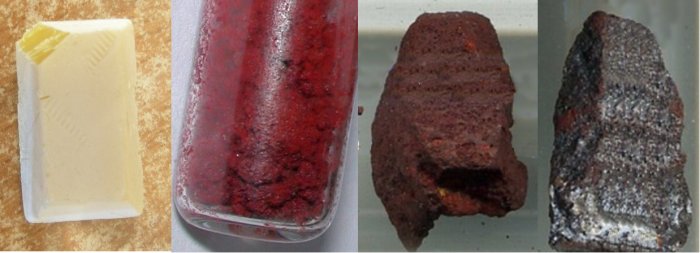
White phosphorus, yellow phosphorus or simply tetraphosphorus (P4) exists as molecules of four phosphorus atoms in a tetrahedral structure, joined by six phosphorus—phosphorus single bonds.[1] The free P4 molecule in the gas phase has a P-P bond length of rg = 2.1994(3) Å as was determined by gas electron diffraction.[2] Despite the tetrahedral arrangement the P4 molecules have no significant ring strain and a vapor of P4 molecules is stable. This is due to the nature of bonding in the P4 tetrahedron which can be described by spherical aromaticity or cluster bonding, that is the electrons are highly delocalized. This has been illustrated by calculations of the magnetically induced currents, which sum up to 29 nA/T, much more than in the archetypical aromatic molecule benzene (11 nA/T).[2]
Molten and gaseous white phosphorus also retains the tetrahedral molecules, until 800 °C (1,500 °F; 1,100 K) when it starts decomposing to P
2 molecules.[3]
White phosphorus is a translucent waxy solid that quickly yellows in light, and impure white phosphorus is for this reason called yellow phosphorus. It is toxic, causing severe liver damage on ingestion and phossy jaw from chronic ingestion or inhalation.
It glows greenish in the dark (when exposed to oxygen). It ignites spontaneously in air at about 50 °C (122 °F), and at much lower temperatures if finely divided (due to melting-point depression). Because of this property, white phosphorus is used as a weapon. Phosphorus reacts with oxygen, usually forming two oxides depending on the amount of available oxygen: P4O6 (phosphorus trioxide) when reacted with a limited supply of oxygen, and P4O10 when reacted with excess oxygen. On rare occasions, P4O7, P4O8, and P4O9 are also formed, but in small amounts. This combustion gives phosphorus(V) oxide, which consists of P4O10 tetrahedral with oxygen inserted between the phosphorus atoms and at their vertices:
- P4 + 5 O2 → P4O10
The odour of combustion of this form has a characteristic garlic smell. White phosphorus is only slightly soluble in water and can be stored under water. Indeed, white phosphorus is safe from self-igniting when it is submerged in water; due to this, unreacted white phosphorus can prove hazardous to beachcombers who may collect washed-up samples while unaware of their true nature.[4][5] P4 is soluble in benzene, oils, carbon disulfide, and disulfur dichloride.
The white allotrope can be produced using several methods. In the industrial process, phosphate rock is heated in an electric or fuel-fired furnace in the presence of carbon and silica.[6] Elemental phosphorus is then liberated as a vapour and can be collected under phosphoric acid. An idealized equation for this carbothermal reaction is shown for calcium phosphate (although phosphate rock contains substantial amounts of fluoroapatite):
- 2 Ca3(PO4)2 + 6 SiO2 + 10 C → 6 CaSiO3 + 10 CO + P4
Other polyhedrane analogues
Although white phosphorus forms the tetrahedron, the simplest possible Platonic hydrocarbon, no other polyhedral phosphorus clusters are known.[7] White phosphorus converts to the thermodynamically-stabler red allotrope, but that allotrope is not isolated polyhedra.
Cubane, in particular, is unlikely to form,[7] and the closest approach is the half-phosphorus compound P4(CH)4, produced from phosphaalkynes.[8] Other clusters are more thermodynamically favorable, and some have been partially formed as components of larger polyelemental compounds.[7]
Red phosphorus

Red phosphorus may be formed by heating white phosphorus to 300 °C (570 °F) in the absence of air or by exposing white phosphorus to sunlight. Red phosphorus exists as an amorphous network. Upon further heating, the amorphous red phosphorus crystallizes. It has two crystalline forms: violet phosphorus and fibrous red phosphorus. Bulk red phosphorus does not ignite in air at temperatures below 240 °C (460 °F), whereas pieces of white phosphorus ignite at about 30 °C (86 °F).
Under standard conditions it is more stable than white phosphorus, but less stable than the thermodynamically stable black phosphorus. The standard enthalpy of formation of red phosphorus is −17.6 kJ/mol.[1] Red phosphorus is kinetically most stable.
It was first presented by Anton von Schrötter before the Vienna Academy of Sciences on December 9, 1847, although others had doubtlessly had this substance in their hands before, such as Berzelius.
Phosphorus is a chemical element; it has symbol P and atomic number 15. All elemental forms of phosphorus are highly reactive and are therefore never found in nature. Elemental phosphorus can be prepared artificially, the two most common allotropes being white phosphorus and red phosphorus. With 31P as its only stable isotope, phosphorus has an occurrence in Earth’s crust of about 0.1%, generally as phosphate rock. A member of the pnictogen family, phosphorus readily forms a wide variety of organic and inorganic compounds, with as its main oxidation states +5, +3 and −3.
The isolation of white phosphorus in 1669 by Hennig Brand marked the scientific community’s first discovery of an element since antiquity. The name phosphorus is a reference to the god of the Morning star in Greek mythology, inspired by the faint glow of white phosphorus when exposed to oxygen. This property is also at the origin of the term phosphorescence, meaning glow after illumination, although white phosphorus itself does not exhibit phosphorescence, but chemiluminescence caused by its oxidation. Its high toxicity makes exposure to white phosphorus very dangerous, while its flammability and pyrophoricity can be weaponised in the form of incendiaries. Red phosphorus is less dangerous and is used in matches and fire retardants.
Most industrial production of phosphorus is focused on the mining and transformation of phosphate rock into phosphoric acid for phosphate-based fertilisers. Phosphorus is an essential and often limiting nutrient for plants, and while natural levels are normally maintained over time by the phosphorus cycle, it is too slow for the regeneration of soil that undergoes intensive cultivation. As a consequence, these fertilisers are vital to modern agriculture. The leading producers of phosphate ore in 2024 were China, Morocco, the United States and Russia, with two-thirds of the estimated exploitable phosphate reserves worldwide in Morocco alone. Other applications of phosphorus compounds include pesticides, food additives, and detergents.
Phosphorus is essential to all known forms of life, largely through organophosphates, organic compounds containing the phosphate ion PO3−4 as a functional group. These include DNA, RNA, ATP, and phospholipids, complex compounds fundamental to the functioning of all cells. The main component of bones and teeth, bone mineral, is a modified form of hydroxyapatite, itself a phosphorus mineral.
History

Phosphorus was the first element to be “discovered”, in the sense that it was not known since ancient times.[12] The discovery is credited to the Hamburg alchemist Hennig Brand in 1669, who was attempting to create the fabled philosopher’s stone.[13] To this end, he experimented with urine, which contains considerable quantities of dissolved phosphates from normal metabolism.[14] By letting the urine rot (a step later discovered to be unnecessary),[15] boiling it down to a paste, then distilling it at a high temperature and leading the resulting vapours through water, he obtained a white, waxy substance that glowed in the dark and burned brilliantly. He named it in Latin: phosphorus mirabilis, lit. ‘miraculous bearer of light‘. The word phosphorus itself (Ancient Greek: Φωσφόρος, romanized: Phōsphoros, lit. ‘light-bearer‘) originates from Greek mythology, where it references the god of the morning star, also known as the planet Venus.[14][16]
Brand at first tried to keep the method secret,[17] but later sold the recipe for 200 thalers to Johann Daniel Kraft from Dresden.[14] Kraft toured much of Europe with it, including London, where he met with Robert Boyle. The crucial fact that the substance was made from urine was eventually found out, and Johann Kunckel was able to reproduce it in Sweden in 1678. In 1680, Boyle also managed to make phosphorus and published the method of its manufacture.[14] He was the first to use phosphorus to ignite sulfur-tipped wooden splints, forerunners of modern matches,[18] and also improved the process by using sand in the reaction:
- 4 NaPO3 + 2 SiO2 + 10 C → 2 Na2SiO3 + 10 CO + P4
Boyle’s assistant Ambrose Godfrey-Hanckwitz later made a business of the manufacture of phosphorus.
In 1777, Antoine Lavoisier recognised phosphorus as an element after Johan Gottlieb Gahn and Carl Wilhelm Scheele showed in 1769 that calcium phosphate is found in bones by obtaining elemental phosphorus from bone ash.[10] Bone ash subsequently became the primary industrial source of phosphorus and remained so until the 1840s.[19] The process consisted of several steps.[20][21] First, grinding up the bones into their constituent tricalcium phosphate and treating it with sulfuric acid:
- Ca3(PO4)2 + 2 H2SO4 → Ca(H2PO4)2 + 2 CaSO4
Then, dehydrating the resulting monocalcium phosphate:
- Ca(H2PO4)2 → Ca(PO3)2 + 2 H2O
Finally, mixing the obtained calcium metaphosphate with ground coal or charcoal in an iron pot, and distilling phosphorus vapour out of a retort:
- 3 Ca(PO3)2 + 10 C → Ca3(PO4)2 + 10 CO + P4

Reviews
There are no reviews yet.